
Seaborne export origins
- Middle East, which dominates global seaborne supply
- Vancouver, Canadian west coast
- Black Sea and Baltic Sea
- US Gulf and US West Coast
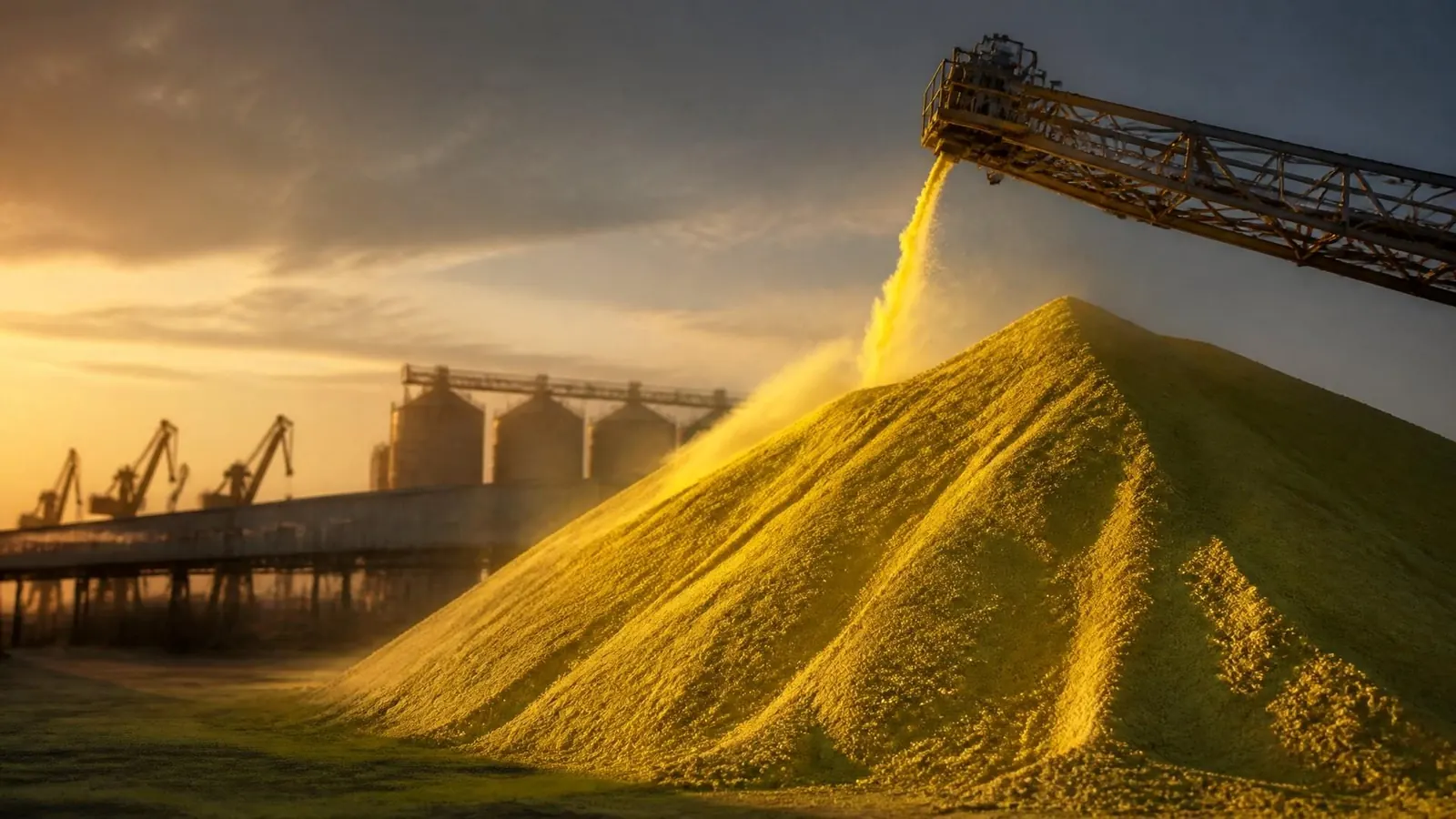
Sulphur · UN 1350
Elemental sulphur trading, specification control and safe carriage, as a dedicated marketing and logistics discipline.
Market structure
Supply follows refining and gas throughput, not sulphur demand. Demand is agricultural. Sulphur price cycles therefore decouple from crude.
USGS Mining Review, May 2025
4% lower than the same period in 2024. USGS
Seaborne export origins
Primary demand regions
Largest end use
Primarily for phosphate fertilizer production: DAP, MAP and SSP. This links sulphur demand to global agriculture rather than to energy.
Sources: USGS Mineral Industry Surveys · USGS Sulfur Statistics · Argus Sulphur Methodology
Traded product forms

| Parameter | Specification |
|---|---|
| Purity, dry basis | 99.5% min |
| Ash | 0.05% max |
| Moisture | 0.50% max |
The principal internationally traded form. Conditioned for reduced dust and friability, enabling long-haul dry-bulk shipment and repeated handling.
| Parameter | Specification |
|---|---|
| Purity, dry basis | 99.5% min |
| Ash | 0.05% max |
| Moisture | 0.50% max |
Broken from block or vat-poured sulphur and assessed separately from granular. Higher dust generation on handling.
| Parameter | Specification |
|---|---|
| Purity, elemental S | 99.9% |
| Moisture | 0.5% max |
| Reduced carbon | 0.1% max |
| Ash | 0.01% max |
| As / Se / Te, each | < 0.1 ppm |
The highest-purity traded grade, moving by barge, pipeline and road tanker over shorter distances.
Specification values are the published product specifications used by Argus Media for its international sulphur price assessments. Source: Argus Sulphur Methodology and Specifications Guide.
Quality & test methods
| Property | Value |
|---|---|
| Bulk density | 1,053 – 1,176 kg/m³ |
| Stowage factor | 0.85 – 0.95 m³/t |
| UN number | UN 1350 |
| IMDG hazard class | Class 4.1, flammable solid |
| Subsidiary hazard | None applicable |
| IMSBC group | Group B, chemical hazard |
| Method | What it measures |
|---|---|
| ASTM D4239 | Sulphur in coal and coke by high-temperature tube furnace combustion. |
| ASTM D2622 | Total sulphur in liquid petroleum and petroleum products by wavelength-dispersive X-ray fluorescence. |
| ASTM D7039 | Sulphur in petroleum products by monochromatic wavelength-dispersive XRF. |
| ASTM D5453 | Total sulphur in light hydrocarbons, motor fuels and oils by ultraviolet fluorescence. |
Sources: IMO IMSBC Code, SULPHUR UN 1350 · ASTM International · Argus Sulphur Methodology
Price benchmarks
Middle East posted prices as at February 2026. These figures are historic reference points, not current offers.
+US$10 vs January. OSP for the Indian subcontinent
+US$4 vs January. Kuwait Sulphur Price
+US$3 vs January. Qatar Sulphur Price
Cargoes sold to load within 40 days of the sale being agreed.
Volume contracted over a minimum three-month shipping period.
A pre-agreed calculation using published prices, applied to future deliveries.
| Basis | Coverage |
|---|---|
| FOB | Vancouver, Middle East (excluding Iran), US Gulf, US West Coast, Black Sea, Baltic Sea. Iran is published separately as fob Iran, lump-granular. |
| CFR | China (granular, and molten-lump-granular), India, Brazil, North Africa. |
| CPT | Europe: one assessment covering road-tanker trade. |
| Freight | Approximately 16 route assessments including Vancouver–China, Middle East–East Coast India, US Gulf–Brazil and Baltic–Brazil. |
Sources: World Fertilizer, citing Argus Media (February 2026 assessments) · Argus Sulphur Methodology
Safe carriage
Hazard 01
Greatest during loading, unloading and hold cleaning. Ventilators need spark-arresting screens, and unsuitable electrical circuits must be isolated.
Hazard 02
Burning sulphur evolves sulphur dioxide. Batten down and use the ship's fixed fire-fighting installation. Do not use water.
Hazard 03
Wet dust or residues form highly corrosive sulphurous acid. Tank tops and trim plates must be lime-washed or painted, and bilges pumped regularly.
Hazard 04
Stow "separated from" foodstuffs. First aid follows the IMO MFAG. Fine grained sulphur and flowers of sulphur must not be carried in bulk at all.
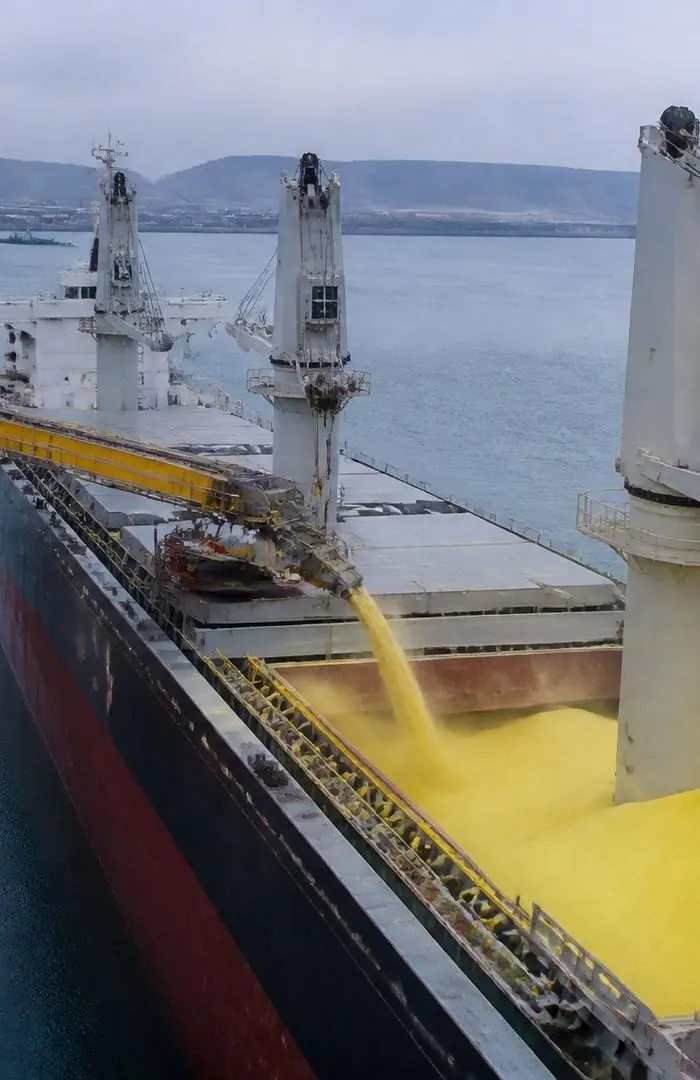
Sources: IMO IMSBC Code, SULPHUR (UN 1350) · UK P&I Club, Carefully to Carry 2023 · Argus Sulphur Methodology
Contract mechanics
ADNOC publishes General Terms and Conditions for the Sale of Sulphur (July 2021 edition), which confirms a price-differential mechanism relative to market price.
Sources: Argus Sulphur Methodology · ICC Incoterms 2020 and UCP 600 · ADNOC GTC for Sale of Sulphur