HoustonOil & Gas Services
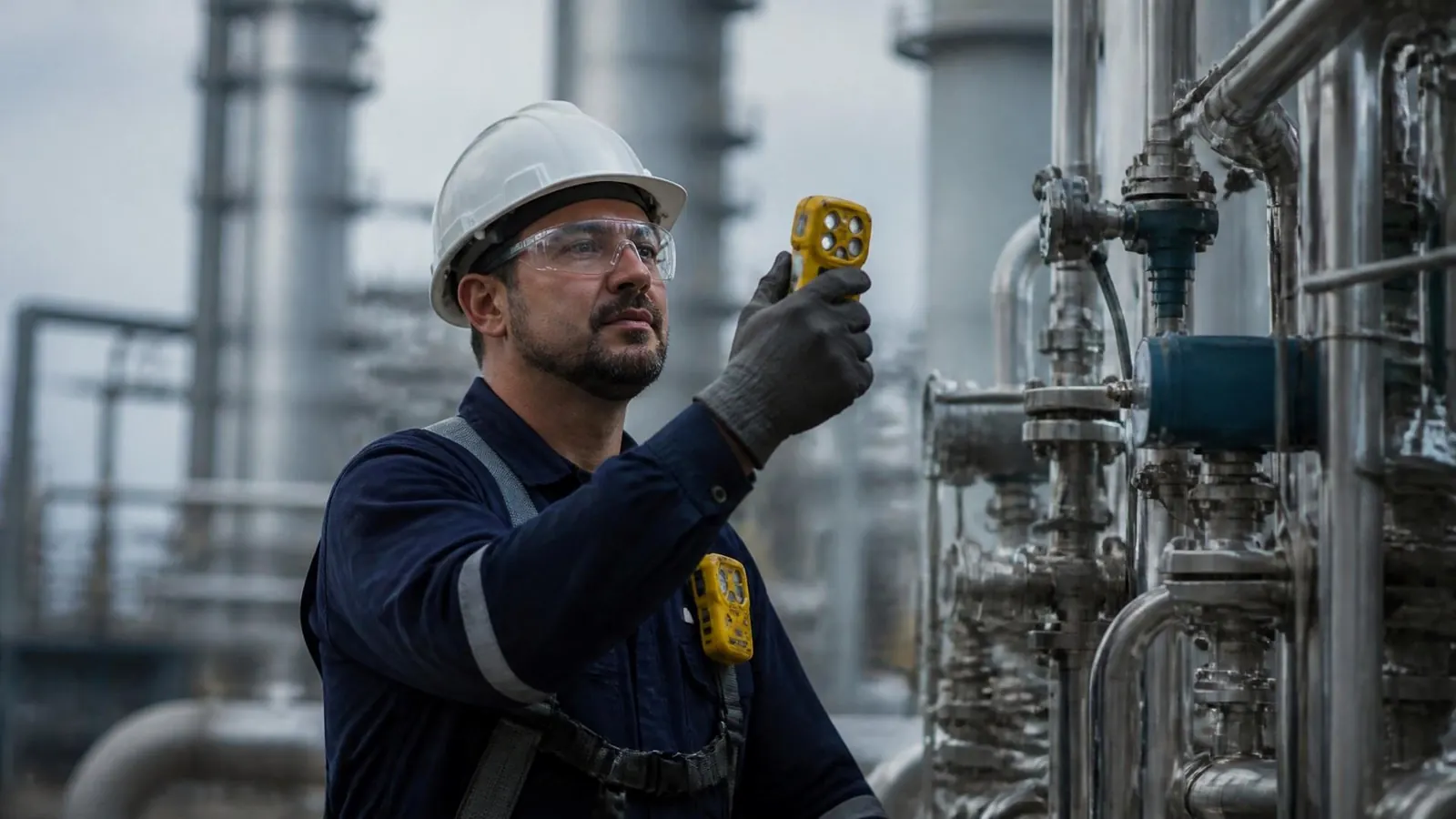
Technician checking a gas detector at a process plant

Health, safety, environment & quality

Safety performance is a prequalification threshold

Visible compliance maturity forms part of the decision threshold before technical or commercial evaluation begins.

Management framework

The management-system standards that structure our controls

Occupational health & safety

ISO 45001:2018

The first international OH&S management-system standard, replacing OHSAS 18001. Built on the Plan-Do-Check-Act cycle, with emphasis on leadership, worker participation, risk assessment, legal compliance, emergency planning and continual improvement. Reviewed and confirmed as current in 2024.

Quality

ISO 9001:2015

Fifth edition. Covers context of the organization, leadership, planning, support, operation, performance evaluation and improvement. The most widely used management-system standard, with more than one million certificates across 189 countries.

Environment

ISO 14001

The 2015 edition introduced stronger emphasis on leadership, risk-based thinking and the High-Level Structure. ISO 14001:2015 is now replaced by ISO 14001:2026, currently in transition, and our framework tracks the revision.

Road traffic safety

ISO 39001:2012

Relevant to field logistics and personnel transport, where driving is a leading exposure.

Greenhouse gas reporting

ISO 14064-1:2018

Principles and requirements at organization level across Scope 1, Scope 2 and Scope 3. The accounting basis for emissions disclosure.

Sources: ISO online catalogue records. Full list in the standards index.

IOGP Report 459

The nine Life-Saving Rules

Around 80% of industry incidents resulting in fatalities involve activities covered by these rules. Report 459-1 adds 13 Start Work Checks aligned to them.

01

Bypassing safety controls

Obtain authorisation before overriding or disabling safety controls.

02

Energy isolation

Verify isolation and zero energy before work begins.

03

Confined space

Obtain authorisation before entering a confined space.

04

Driving

Follow safe driving rules.

05

Safe mechanical lifting

Plan lifting operations and control the area.

06

Hot work

Control flammables and ignition sources.

07

Work authorisation

Work with a valid permit when required.

08

Working at heights

Protect yourself against a fall when working at height.

09

Line of fire

Keep yourself and others out of the line of fire.

Process safety

Measuring what precedes a catastrophic release

API RP 754 (third edition, August 2021) sets four tiers on a leading-to-lagging continuum. Tiers 1 and 2 suit public reporting; Tiers 3 and 4 are for internal use.

Tier 1 · most lagging

Loss of primary containment with the greatest consequence.

Tier 2

Loss of primary containment with lesser consequence, predictive of higher-consequence events.

Tier 3

Challenges to safety systems: safe-operating-limit excursions and demands on safety systems.

Tier 4 · most leading

Operating discipline and management-system performance indicators.

Personal safety and human performance

  • TRIR / TRCF, LTIF / LTIR and the Fatal Accident Rate are computed per million hours worked, which makes them comparable between contractors of different size.
  • IOGP notes that 376 lives could potentially have been saved since 2008 by following the revised nine rules.
  • IOGP Reports 452, 453, 552 and 621 cover human-performance principles.

Sources: OSHA 1910.119 · API RP 754 Fact Sheet · IOGP

Hydrogen sulphide control

The exposure limits that govern every sour-service operation

Published occupational limits and consequence levels, on a logarithmic scale in parts per million.

NIOSH REL 10 ppm 10-minute ceiling
OSHA Construction 10 ppm 8-hour limit
OSHA Shipyard 10 ppm 8-hour limit
OSHA General Industry ceiling 20 ppm Ceiling limit
OSHA General Industry peak 50 ppm Up to 10 minutes, if no other exposure
NIOSH IDLH 100 ppm Immediately dangerous to life and health
Consequence 500–700 ppm Collapse within 5 minutes; death after 30 to 60 minutes
Consequence 700–1,000 ppm Rapid unconsciousness within one to two breaths

Flammability

H₂S explosive range in air: 4.3% to 45%.

ANSI/API RP 49

Recommended Practice for Safe Drilling of Wells Containing Hydrogen Sulphide.

29 CFR 1910.146

A hazardous atmosphere is oxygen below 19.5% or above 23.5%, or flammable gas exceeding 10% of the lower flammable limit.

Sources: OSHA Hydrogen Sulfide hazards and standards pages · OSHA 29 CFR 1910.146 · ANSI/API RP 49

Work control systems

Nothing starts without authorisation, isolation and a verified atmosphere

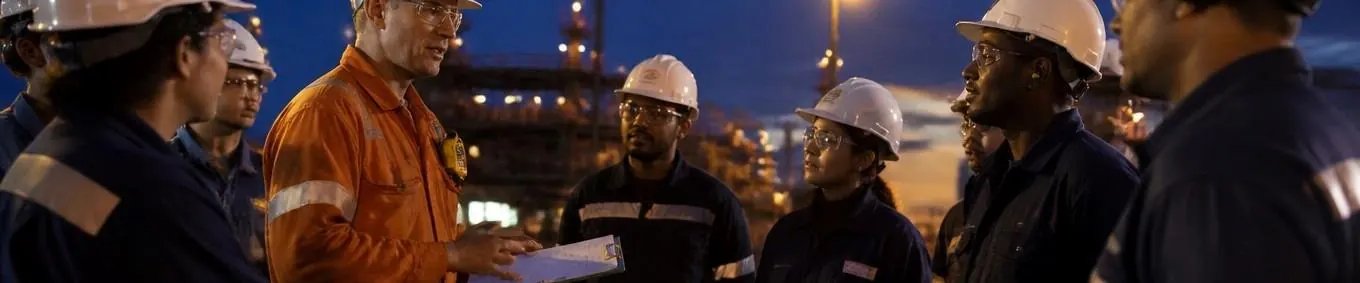
Crew in a pre-job briefing
Every permit reviewed with the crew before work commences

Control 01

Permit to work

Work proceeds only under a valid permit where required (Rule 7). Job Safety Analysis is completed before permit issue.

Control 02

Energy isolation

Lock-Out / Tag-Out under 29 CFR 1910.147. Isolation and zero energy verified before work begins (Rule 2).

Control 03

Confined space entry

29 CFR 1910.146: written programme, atmospheric testing, an attendant and rescue procedures. Oxygen between 19.5% and 23.5%, flammable gas below 10% LFL.

Control 04

Hot work

Flammables and ignition sources controlled first (Rule 6). Critical in sulphur handling areas, where dust presents an explosion hazard.

Quality assurance

Third-party verification

  • Independent audits supporting operational, environmental and financial control credibility
  • Cargo quality and quantity certification by SGS, Bureau Veritas and Intertek
  • Documented corrective-action tracking to closure

Analytical certification

  • Product quality determined by published ASTM methods: D2622, D7039, D5453 and D4239
  • Certificates of analysis issued against the contractual specification, not a generic datasheet
Laboratory technician testing a sample
Specification confirmed before cargo acceptance

Environment & emissions

Measured, reported and aligned to recognised initiatives

Processing facility with a flare stack

Flaring reduction

Zero Routine Flaring by 2030

The World Bank initiative to end routine gas flaring no later than 2030, within its Global Flaring and Methane Reduction Partnership, supported by IPIECA.

Methane reporting

OGMP 2.0

A measurement-based framework covering Scope 1 methane across the value chain, from Level 1 generic factors to Level 5 reconciliation with measurement-based inventories.

Emissions accounting

ISO 14064-1:2018

Quantification and reporting of greenhouse-gas emissions and removals across Scope 1, Scope 2 and Scope 3.

Marine air emissions

MARPOL

First adopted in 1973, with Annex VI on air pollution added in 1997. 21 of the IMO's 51 treaty instruments are environment-related.

Sulphur oxide control

0.50% / 0.10% m/m

The global marine fuel sulphur cap under MARPOL Annex VI Regulation 14, tightening inside Emission Control Areas, with the Mediterranean added from 1 May 2025.

Sources: World Bank ZRF · OGMP 2.0 Reporting Framework · IPIECA · ISO 14064-1 · IMO

Emergency response

Oil spill preparedness

  • OPA 90. The Oil Pollution Act of 1990 strengthened EPA authority; Title I set higher liability limits and financial-responsibility requirements.
  • Tank vessels, non-tank vessels and facilities prepare and submit response plans to the US Coast Guard (33 CFR Part 154 Subpart F; 40 CFR Part 112).
  • IMO OPRC. The 1990 Convention and 2000 OPRC-HNS Protocol cover international preparedness, response and cooperation.
  • HAZWOPER. OSHA 29 CFR 1910.120 governs how responders are trained and equipped.

Sources: EPA · USCG NPFC · IMO · OSHA

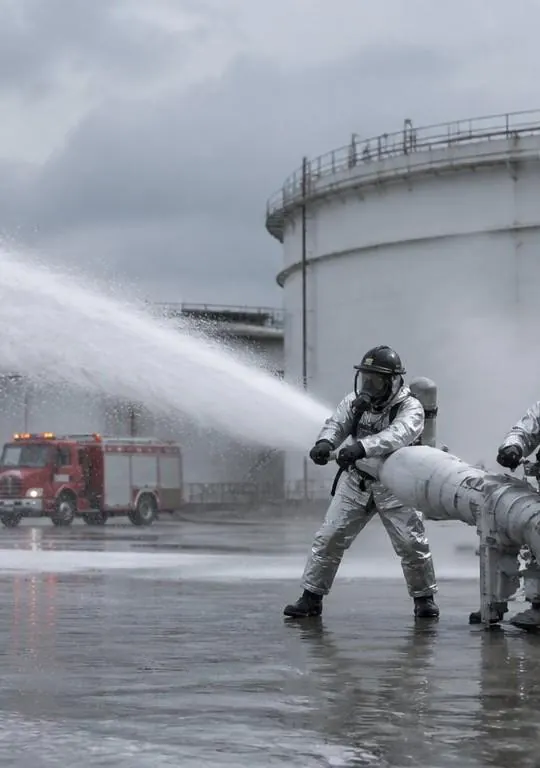
Responders spraying water at a tank during a drill